Codes
Although not exhibited, this code informs works in my practice and provides their structural and generative basis.
Tone Code
English Alphabet
Tone Code is a visual alphabet adapted from Morse Code. Each letter of the English language is represented by a unique combination of light and dark tones. Unlike Morse Code, eight letters and their corresponding characters have been swapped so that the more frequently used letters contain fewer characters. I have also created code for punctuation, using unique combinations of light and dark tones.
Tone Code is organised across three horizontal lines. Letters run along the middle line, while punctuation is placed above and below it. Letters are separated by a single neutral-coloured bead, and three neutral beads mark spaces between words. Punctuation is read perpendicular to the letters and follows them sequentially. It is never placed directly above or below a letter unless it indicates a capital letter. Tone Code can be read and written in any direction: left to right, top to bottom, right to left, and bottom to top.

Graphic Illustration of an example of Tone Code, 2021
Please note that here, neutral blocks are represented as vertical lines.
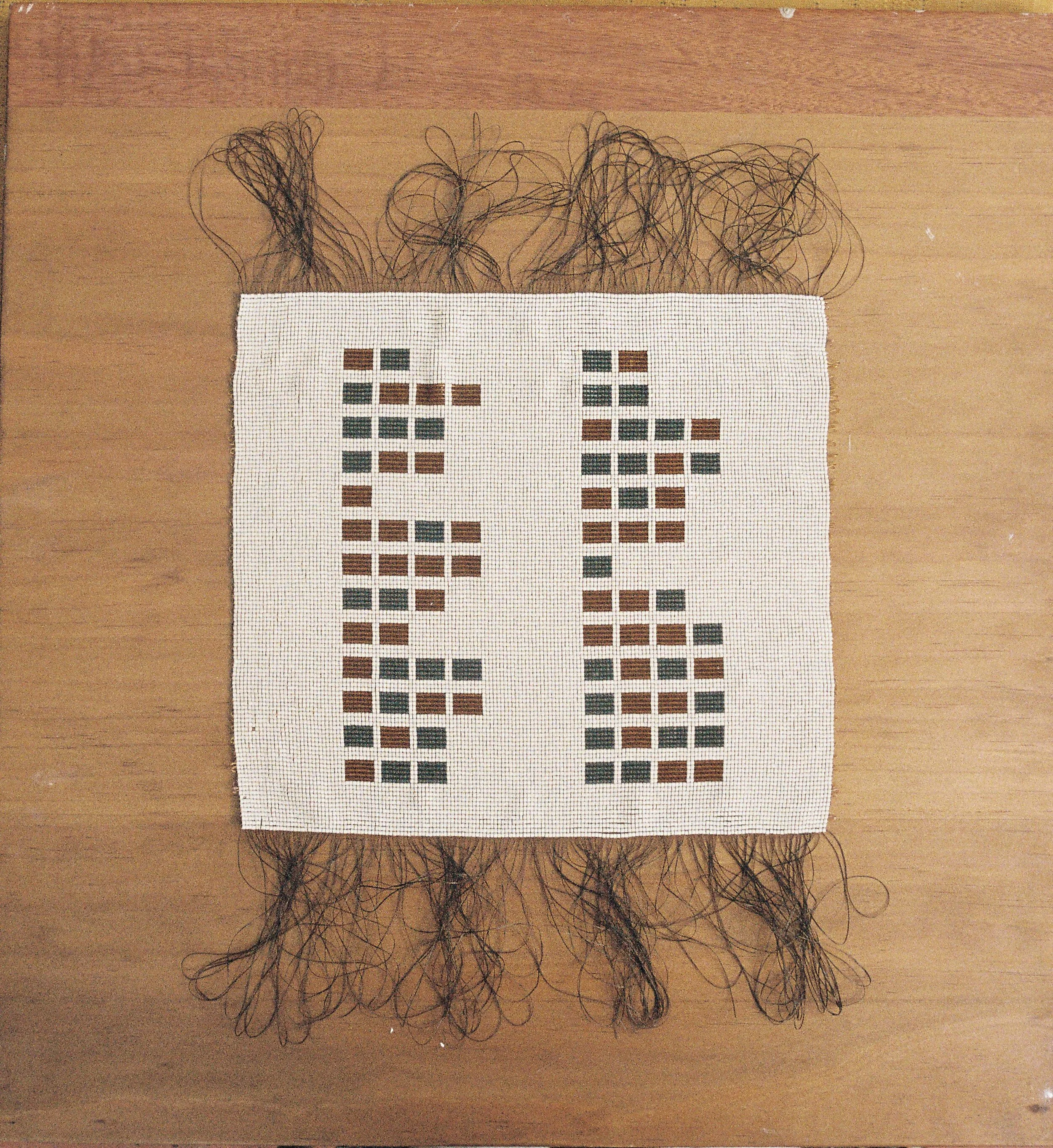
Tone Code, 2021
Glass beads, thread
20cm x 20cm

Graphic Illustration of Tone Code with corresponding letters and punctuation, 2021

Initial Workings, 2021; ink and paper

Parallax by Don Paterson, 2021; Glass beads, thread
Beading in Tone Code
Music Code
Western Music Notation
Music Code is a visual music notation system. Rhythm and rests, ties, octaves, and notes are separated across four horizontal lines. Rhythm and rests, as well as notes and octaves, are read with a left alignment and separated by a single neutral-coloured bead. Ties are placed in the gaps between rhythm and rests, and between octaves and notes.

Initial Workings, 2023; pencil and paper

Translated segment of the song ‘Opus No. 1’ by Tim Carleton, 2023

Graphic Illustration of an example of Music Code, 2023

Translated segment of the song ‘Opus No. 1’ by Tim Carleton in a beaded work, 2023